Performance / Benchmarks
jero is built for speed, but the only honest way to talk about speed is with numbers and a clear account of how they were produced. This page is that account, and the entire benchmark (every app's source, the harness, and the full methodology) is public at api-benchmarks.
TL;DR: across four workloads benchmarked side by side against ten other frameworks (Python: Django Bolt, Blacksheep, Robyn, Litestar, FastAPI, Flask, Django Ninja; Go: Gin; Bun: Elysia; Java: Spring Boot), jero is the fastest Python ASGI framework in every scenario, and the fastest Python framework outright on the proxy and database paths. On the pure framework path the top four (Elysia, Gin, Django Bolt, jero) finish within 3% of each other: jero runs at Go speed there. Django Bolt, whose built-in Rust server handles routing and serialization outside Python, edges that test by ~1% and takes the authed write outright; jero leads it everywhere the request goes past the framework. Go and Bun top the raw table; Spring Boot lands mid-field at five to ten times everyone's resident memory (a JVM-defaults figure; see the caveats).
Read the caveats
These are favourable, constrained conditions, and a microbenchmark is not your application.
At a glance
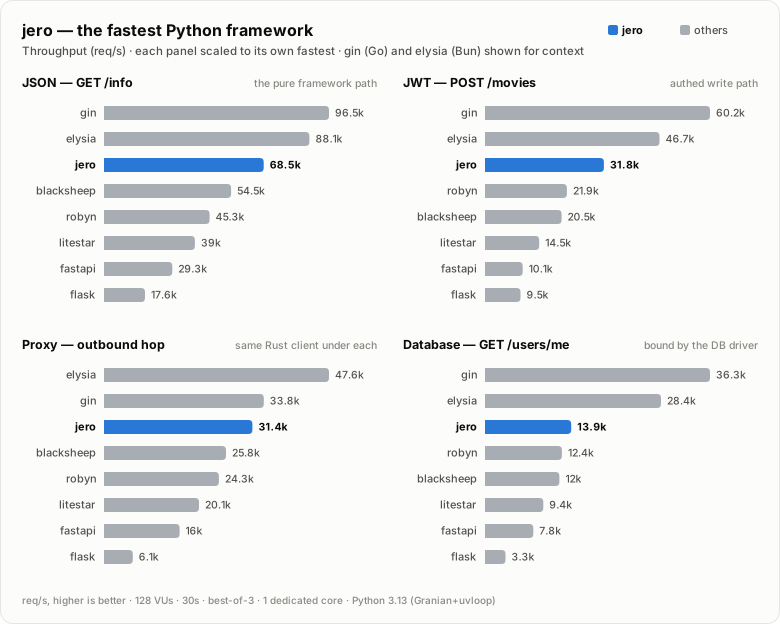
The whole field on all four workloads. Each panel is scaled to its own fastest framework, so the bars show the ranking within that test; the labels keep the absolute throughput. jero is the fastest Python ASGI framework in every one. Django Bolt and Robyn ship their own Rust servers, and gin (Go), elysia (Bun), and spring-boot (Java) are shown for cross-language context.
How the numbers were produced
The full account (every framework's app code, the compose files, the k6 scenarios, and
the methodology) lives in the
api-benchmarks repo, and every run
writes a complete report (including per-container CPU and memory accounting) to its
reports/ directory. The suite is written by jero's author; the code is public
precisely so you don't have to take fairness on trust. If a framework looks
shortchanged, open an issue there. The load-bearing points:
- One framework alive at a time. Each framework runs in its own compose stack alongside freshly started dependencies (Postgres, the Rust upstream, the k6 runner), torn down before the next framework starts. Nothing else competes for the machine, so each number reflects that framework alone.
- Best-of-3. k6 drives a fixed virtual-user count for a fixed
duration; every
(framework, scenario)pair runs three times and the attempt with the highest throughput is kept. Repeating and keeping the best beats down run-to-run noise so the comparison reflects each framework's ceiling, not a noisy sample. - One worker, one core. Every service runs one worker (Gin at
GOMAXPROCS=1, Django Bolt at--processes 1), pinned to a single dedicated CPU core viacpusetaffinity rather than a CFS quota, because a quota throttles a saturated container every scheduler period and pollutes the tail. The pin confines all of a framework's threads, including GIL-releasing extensions like msgspec and the DB drivers. This is a like-for-like, single-core comparison, not a test of how well each scales across cores. - Equal budgets, equal work. The DB pool and outbound-HTTP pool are capped at 64 connections for every framework in every language. Every framework runs the same scenarios against the same scoring; every JWT endpoint hand-decodes the same bearer token with PyJWT; every Python framework makes its upstream call through the same Rust-based HTTP client, pyreqwest; and the whole async Python fleet (the two Django frameworks deliberately included, bypassing Django's ORM) reads Postgres through the same Rust-based driver, psqlpy, so the database test measures the framework rather than a data layer. Beyond that, each framework uses its own idiomatic, recommended tools, and the real differences that creates (FastAPI's response re-validation, typed vs passthrough upstream parsing, serializer choices) are documented in the repo as known, intended differences rather than normalised away.
Run configuration
| Setting | Value |
|---|---|
| Machine | Amazon EC2 c9g.2xlarge, eu-central-1 |
| Machine specs | AWS Graviton5 (arm64), 8 vCPUs (physical cores, no SMT), 16 GiB |
| Concurrency | 128 VUs |
| Duration | 60s per attempt |
| Best-of-N | 3 attempts, highest throughput kept |
| CPU | 1 dedicated core per framework (cpuset affinity) |
| Workers | 1 (Gin at GOMAXPROCS=1, Django Bolt at --processes 1) |
| Python | 3.13 (pinned image, every Python framework) |
| Python server | granian + uvloop (Flask via granian WSGI; Robyn and Django Bolt ship their own Rust servers) |
| Outbound client | pyreqwest (Rust) for every Python framework |
| Pools | 64 connections per framework, database and outbound HTTP alike |
Results
req/s is throughput (higher is better); mean and p99 are request latency (lower is
better). vs jero is throughput relative to jero. Every framework returned 100%
successful responses in every run, so that column is omitted. Frameworks are ordered
fastest → slowest within each scenario.
1. GET /info: the pure framework path
Route → build a typed JSON response with a custom response header → encode. No I/O. This isolates routing and serialization, and is the closest thing to a measure of the framework's own per-request overhead.
| Framework | req/s | mean | p99 | vs jero |
|---|---|---|---|---|
| elysia (Bun) | 50.3k | 2.42ms | 10.88ms | 1.03× |
| gin (Go) | 50.1k | 2.43ms | 10.90ms | 1.02× |
| django-bolt | 49.6k | 2.46ms | 11.47ms | 1.01× |
| jero | 49.0k | 2.56ms | 10.99ms | 1.00× |
| blacksheep | 41.5k | 3.03ms | 12.05ms | 0.85× |
| robyn | 36.4k | 3.43ms | 12.86ms | 0.74× |
| spring-boot (Java) | 32.6k | 3.85ms | 12.84ms | 0.66× |
| litestar | 32.2k | 3.94ms | 12.86ms | 0.66× |
| fastapi | 24.5k | 5.19ms | 14.27ms | 0.50× |
| flask | 19.4k | 6.57ms | 16.82ms | 0.40× |
| django-ninja | 2.4k | 52.70ms | 96.01ms | 0.05× |
The top four (Bun, Go, Rust-served Django, and jero) sit within 3% of each other, and jero is the only one of them doing the whole request in a Python-visible framework on a Python ASGI server. Within the ASGI field jero leads by 1.2× Blacksheep, 1.5× Litestar, 2× FastAPI. One honest asterisk on the cluster above: jero ran at ~90% CPU, close to its genuine single-core ceiling, while Elysia (41%), Gin (65%), and Bolt (78%) finished with headroom, so read their numbers as at least what the table shows.
2. POST /movies: the authed write path (JWT)
Bearer/JWT auth → decode and validate a five-field request body → handler → encode →
201. The realistic write path for a typed JSON API.
| Framework | req/s | mean | p99 | vs jero |
|---|---|---|---|---|
| gin (Go) | 40.7k | 2.91ms | 13.04ms | 1.70× |
| elysia (Bun) | 38.4k | 3.20ms | 13.56ms | 1.60× |
| django-bolt | 37.3k | 3.28ms | 13.84ms | 1.55× |
| jero | 24.0k | 5.27ms | 16.50ms | 1.00× |
| spring-boot (Java) | 21.7k | 5.80ms | 16.94ms | 0.90× |
| robyn | 20.3k | 6.24ms | 16.48ms | 0.85× |
| blacksheep | 16.7k | 7.63ms | 18.47ms | 0.69× |
| litestar | 13.1k | 9.71ms | 21.09ms | 0.55× |
| flask | 10.9k | 11.70ms | 21.06ms | 0.45× |
| fastapi | 9.2k | 13.80ms | 28.49ms | 0.39× |
| django-ninja | 2.3k | 56.42ms | 104.20ms | 0.09× |
jero leads the ASGI field by its widest margin of the four: 1.4× Blacksheep, 1.8×
Litestar, and 2.6× FastAPI, which drops below even sync Flask here under the weight of
re-validating its own response against the response_model. Django Bolt's Rust core
takes the Python crown, and Spring Boot lands within 10% of jero, at ~628M resident to
jero's ~81M (a JVM-defaults figure; see "How to read this").
3. GET /catalog: the outbound hop
The service makes an outbound HTTP call to the Rust upstream (authenticated with a bearer API key) and returns the payload. Every Python framework issues that call through the same Rust-based HTTP client (pyreqwest), so this scenario measures the framework around the client, not the client itself.
| Framework | req/s | mean | p99 | vs jero |
|---|---|---|---|---|
| elysia (Bun) | 40.9k | 3.02ms | 12.85ms | 1.64× |
| gin (Go) | 29.4k | 4.24ms | 13.91ms | 1.17× |
| jero | 25.0k | 5.06ms | 15.12ms | 1.00× |
| blacksheep | 20.6k | 6.17ms | 16.47ms | 0.82× |
| django-bolt | 20.3k | 6.27ms | 16.21ms | 0.81× |
| robyn | 17.9k | 7.10ms | 16.57ms | 0.72× |
| litestar | 17.1k | 7.44ms | 18.23ms | 0.68× |
| spring-boot (Java) | 16.0k | 7.93ms | 15.65ms | 0.64× |
| fastapi | 12.8k | 9.94ms | 22.88ms | 0.51× |
| flask | 10.1k | 12.60ms | 20.78ms | 0.40× |
| django-ninja | 2.9k | 44.52ms | 85.68ms | 0.11× |
jero is the fastest Python framework outright on the outbound hop, within ~15% of the Go service, and it gets there while decoding the upstream payload into a typed model, where Django Bolt, Blacksheep, and Elysia relay the raw bytes straight through. With the client held constant across the Python field, what separates these rows is the framework. Elysia is the fastest proxy overall.
4. GET /users/me: bound by the database driver
Bearer/JWT auth, then a row read from Postgres. Every request pays the database driver's cost, which compresses the field and plays to Go's cheap native driver. The whole async Python fleet (the Django pair included, by the suite's documented exception to per-framework idiom) reads through the same Rust-based driver (psqlpy), so these rows compare frameworks, not data layers.
| Framework | req/s | mean | p99 | vs jero |
|---|---|---|---|---|
| gin (Go) | 32.3k | 3.82ms | 14.22ms | 2.89× |
| elysia (Bun) | 26.0k | 4.84ms | 14.85ms | 2.33× |
| spring-boot (Java) | 16.6k | 7.65ms | 17.06ms | 1.49× |
| jero | 11.2k | 11.43ms | 21.47ms | 1.00× |
| blacksheep | 9.8k | 13.06ms | 24.53ms | 0.88× |
| django-bolt | 9.6k | 13.30ms | 27.95ms | 0.86× |
| robyn | 9.3k | 13.71ms | 24.86ms | 0.83× |
| litestar | 8.2k | 15.63ms | 28.31ms | 0.73× |
| fastapi | 6.6k | 19.46ms | 36.21ms | 0.59× |
| flask | 6.0k | 21.16ms | 39.50ms | 0.54× |
| django-ninja | 1.9k | 68.85ms | 131.21ms | 0.17× |
jero is the fastest Python framework, at a narrowed margin (1.1× Blacksheep), because when the driver dominates the request, the framework matters less. Notably, Django Bolt's Rust-server advantage disappears here: once every request spends its time waiting on Postgres, Bolt lands mid-pack with the other Python frameworks. The compiled languages pull clear on their native drivers; that is the honest ceiling on what any Python framework can do for a database-bound service.
How to read this
- jero is the fastest Python ASGI framework in all four scenarios, and the fastest Python framework outright on the proxy and database paths. That is the durable claim. Against the frameworks that share its architecture (Blacksheep, Litestar, and FastAPI on the same granian server), jero leads every test, by 1.1× to 2.6×.
- On the pure framework path, jero runs at compiled-language speed. Elysia, Gin,
Django Bolt, and jero finish within 3% of each other on
GET /info, though the others had CPU headroom left and jero was near its ceiling, so read the cluster as parity under these conditions, not jero beating Go. - Django Bolt is the closest Python rival, and the comparison is instructive. Its built-in Rust server does routing and serialization outside Python, which wins it the authed write and a ~1% edge on JSON. On the proxy and database paths, where the request's time is spent beyond the framework, that advantage evaporates and jero leads it. A Rust core accelerates exactly the slice of the request it covers.
- Django Ninja's numbers are about Django's request machinery, not Ninja's binding. It sits an order of magnitude below the field on every test, with the same driver, client, and hand-rolled auth as everyone else, because every request runs the full Django request cycle on a single core. Bolt, which bypasses that machinery entirely, is the controlled experiment proving where the cost lives.
- Go, Bun, and Java are context, not competition. Gin and Elysia split the four
outright wins between them; Spring Boot runs mid-field (beating jero on the database
test, trailing it elsewhere) while holding ~615–670M of resident memory against the
Python field's ~50–140M and Gin's ~12–34M. Read the JVM number with care: under
default heap sizing the JVM commits memory up front and rarely returns it, so much of
that footprint is reserved heap rather than working set, and a tuned
-Xmxwould show far less. It is the honest cost of idiomatic defaults, not Spring Boot's floor. Python is not faster than Go, and this page doesn't claim it is. - The proxy result is the framework, not the client. With the same Rust-based HTTP client under every Python framework, jero relays a typed, validated upstream payload within ~15% of the Go service. Pick a pure-Python client instead and the client's ceiling swallows the whole Python field: the client library matters more than the framework on that path.
- On the database path, the driver decides it. Go's native driver is well ahead; jero stays ahead of every Python framework, which is the most it can do there.
- A benchmark is not your app. Single worker, one core, fixed payloads, best-of-N on an idle EC2 host. Real workloads have more moving parts. Treat these as directional evidence that jero's per-request overhead is low, not as a promise about your production numbers. For a workload that matters to you, the only number worth trusting is the one you measure yourself.
Where jero's design earns these numbers: all type introspection happens once, at startup. The request path is dict lookup → msgspec decode → handler call → encode, and nothing is ever added to it. See Philosophy for the reasoning.
What middleware and CORS cost
Middleware and CORS are compiled at wiring
rather than layered as app wrappers, so their cost is per tier, opt-in, and zero on
routes nothing covers. Measured with the in-process hot-path harness (bench.py's
POST-echo shape, ~1.3µs/request baseline; in-process numbers amplify framework deltas
relative to a real server, where socket I/O dominates):
| configuration | relative cost |
|---|---|
| no middleware, no CORS | 1.00× |
wildcard CORS / a constant response_headers block |
~1.02× |
| origin allow-list CORS | ~1.15× |
on-scope intercept (falling through) |
~1.4× |
observe |
~1.6× |
response_headers method |
~1.9× |
For contrast, a single onion-style ASGI wrapper doing nothing but appending one constant CORS pair measured ~1.3× on the same harness: paid on every request, whether or not it applied, and before it does anything a real middleware does. That number is why jero's middleware is a compiled protocol instead: one bare wrapper already costs what the compiled model's mid tiers do, and the compiled model's floor is free.
Measure it yourself
A single self-contained script drives jero, Litestar, BlackSheep, and FastAPI in-process as bare ASGI callables (no server, no sockets), isolating pure framework overhead (routing, binding/validation, serialization) on your own machine in under a minute. Each is measured against a hand-rolled raw ASGI app serving the same three-endpoint API: no framework, but kept honest (hand routing, typed validating msgspec decode, typed encode), while skipping everything a framework gives you (404/405 semantics, HEAD/OPTIONS, error envelopes). That raw app is the theoretical ceiling the frameworks are measured against.
This is a different test from the four scenarios above
The tables above measure throughput you'd actually get: a real server, real
sockets, 128 concurrent clients. This script measures how close each framework gets
to the theoretical maximum for the work itself. The hand-rolled raw row is that
maximum (identical routing, decode, and encode with no framework at all), so read each
framework's distance from raw as the price of what it adds for you.
Because there's no server in the loop, the fixed per-request cost (socket, ASGI server,
event loop) that compresses the networked numbers disappears, so the gaps here run
far wider than any vs jero column above (jero lands close to raw; the others
trail it by more). Read this as a relative ordering-and-headroom check, not a re-run
of the throughput tables.
The script declares its dependencies inline (PEP 723), so uv runs it in a throwaway environment; nothing is installed into your project:
curl -LsSf https://raw.githubusercontent.com/RogerThomas/jero/main/benchmarks/micro_bench.py | uv run -
That executes a script fetched over the network; the full source is right below, so
read it first if you'd rather. To run it locally, save it as micro_bench.py and
uv run micro_bench.py; pin versions or tweak the scenarios by editing it.
# /// script
# requires-python = ">=3.13"
# dependencies = [
#     "blacksheep",
#     "fastapi",
#     "jero",
#     "litestar",
#     "msgspec",
#     "rich",
# ]
# ///
"""In-process ASGI micro-benchmark: jero vs Litestar vs BlackSheep vs FastAPI vs a
hand-rolled raw ASGI app, all serving the same three-endpoint API.

Every app is driven directly as an ASGI callable — no server, no sockets — so what you
measure is each framework's own per-request overhead: routing, binding/validation, and
serialization. That makes the numbers a per-core ceiling, not a production promise.

Scenarios (identical raw ASGI scopes for every app):
  plain   GET  /ping                      -> tiny JSON body
  bind    GET  /items/{item_id}?limit=10  -> path + query binding, JSON body
  body    POST /items (JSON, 3 fields)    -> body decode/validation, JSON echo

Fairness notes:
  - The "raw ASGI" app uses no framework but still does honest work with msgspec:
    hand-rolled routing, path/query extraction, a typed validating decode of the POST
    body, and a typed encode of every response. It skips everything a framework gives
    you (404/405 semantics, HEAD/OPTIONS, content-type checks, error envelopes).
  - Each framework app is written the way its own documentation recommends.
  - BlackSheep uses its documented msgspec JSON hook (its fastest configuration).
  - Tweak freely: pin versions in the dependencies block above, change N_MEASURE,
    add a framework, add a scenario.
"""

import asyncio
import time

N_WARMUP = 2_000
N_MEASURE = 20_000
BEST_OF = 3

POST_BODY_CAMEL = b'{"name":"gizmo","priceCents":499,"tags":["a","b"]}'
POST_BODY_SNAKE = b'{"name":"gizmo","price_cents":499,"tags":["a","b"]}'


# --------------------------------------------------------------------- harness
def make_scope(method: str, path: str, query: bytes = b"", body: bool = False) -> dict:
    headers = [(b"host", b"bench")]
    if body:
        headers.append((b"content-type", b"application/json"))
    return {
        "type": "http",
        "asgi": {"version": "3.0", "spec_version": "2.3"},
        "http_version": "1.1",
        "method": method,
        "scheme": "http",
        "path": path,
        "raw_path": path.encode(),
        "query_string": query,
        "root_path": "",
        "headers": headers,
        "client": ("127.0.0.1", 1234),
        "server": ("127.0.0.1", 80),
    }


SCENARIOS = [
    ("plain GET", make_scope("GET", "/ping"), False),
    ("path+query GET", make_scope("GET", "/items/abc123", query=b"limit=10"), False),
    ("POST w/ body", make_scope("POST", "/items", body=True), True),
]


async def run_lifespan_startup(app) -> None:
    """Send lifespan.startup and wait for completion (frameworks wire routes here)."""
    started = asyncio.Event()

    async def receive():
        return {"type": "lifespan.startup"}

    async def send(message):
        if message["type"] == "lifespan.startup.failed":
            raise RuntimeError(message.get("message", "lifespan startup failed"))
        if message["type"] == "lifespan.startup.complete":
            started.set()

    task = asyncio.ensure_future(app({"type": "lifespan"}, receive, send))
    await started.wait()
    task.cancel()


async def bench_one(app, scope_template: dict, body: bytes | None) -> float:
    """Seconds for N_MEASURE requests (asserts 2xx on every response)."""

    def make_receive():
        sent = False

        async def receive():
            nonlocal sent
            if body is not None and not sent:
                sent = True
                return {"type": "http.request", "body": body, "more_body": False}
            return {"type": "http.disconnect"}

        return receive

    async def send(message):
        if message["type"] == "http.response.start":
            assert 200 <= message["status"] < 300, f"unexpected status {message['status']}"

    async def one():
        await app(dict(scope_template), make_receive(), send)

    for _ in range(N_WARMUP):
        await one()
    start = time.perf_counter()
    for _ in range(N_MEASURE):
        await one()
    return time.perf_counter() - start


# ------------------------------------------------------- raw ASGI (honest work)
def build_raw():
    import msgspec

    class Ok(msgspec.Struct):
        ok: bool

    class ItemIn(msgspec.Struct, rename="camel"):
        name: str
        price_cents: int
        tags: list[str]

    class Item(msgspec.Struct, rename="camel"):
        id: str
        name: str
        price_cents: int
        tags: list[str]

    encoder = msgspec.json.Encoder()
    item_in_decoder = msgspec.json.Decoder(ItemIn)

    async def send_json(send, payload: bytes) -> None:
        await send(
            {
                "type": "http.response.start",
                "status": 200,
                "headers": [
                    (b"content-type", b"application/json"),
                    (b"content-length", b"%d" % len(payload)),
                ],
            }
        )
        await send({"type": "http.response.body", "body": payload})

    async def app(scope, receive, send):
        method, path = scope["method"], scope["path"]
        if method == "GET" and path == "/ping":
            await send_json(send, encoder.encode(Ok(ok=True)))
        elif method == "GET" and path.startswith("/items/"):
            item_id = path[len("/items/") :]
            limit = 20
            for pair in scope["query_string"].decode("latin-1").split("&"):
                key, _, value = pair.partition("=")
                if key == "limit" and value:
                    limit = int(value)
            item = Item(id=item_id, name="gizmo", price_cents=limit, tags=["a"])
            await send_json(send, encoder.encode(item))
        elif method == "POST" and path == "/items":
            chunks = []
            while True:
                message = await receive()
                chunks.append(message.get("body", b""))
                if not message.get("more_body"):
                    break
            data = item_in_decoder.decode(b"".join(chunks))
            item = Item(id="new", name=data.name, price_cents=data.price_cents, tags=data.tags)
            await send_json(send, encoder.encode(item))
        else:
            raise AssertionError(f"unrouted request {method} {path}")

    return app


# ------------------------------------------------------------------------ jero
def build_jero():
    from jero import BaseApp, Endpoint, Struct

    class Ok(Struct):
        ok: bool

    class ItemPath(Struct):
        item_id: str

    class PageParams(Struct):
        limit: int = 20

    class ItemIn(Struct, rename="camel"):
        name: str
        price_cents: int
        tags: list[str]

    class Item(Struct, rename="camel"):
        id: str
        name: str
        price_cents: int
        tags: list[str]

    class PingEndpoint(Endpoint, path="/ping"):
        async def get(self) -> Ok:
            return Ok(ok=True)

    class ItemEndpoint(Endpoint, path="/items/{item_id}"):
        async def get(self, path: ItemPath, params: PageParams) -> Item:
            return Item(id=path.item_id, name="gizmo", price_cents=params.limit, tags=["a"])

    class ItemsEndpoint(Endpoint, path="/items"):
        async def post(self, json: ItemIn) -> Item:
            return Item(id="new", name=json.name, price_cents=json.price_cents, tags=json.tags)

    class App(BaseApp):
        async def wire(self) -> None:
            self._include_endpoint(PingEndpoint())
            self._include_endpoint(ItemEndpoint())
            self._include_endpoint(ItemsEndpoint())

    return App()


# -------------------------------------------------------------------- litestar
def build_litestar():
    from dataclasses import dataclass

    from litestar import Litestar, get, post

    @dataclass
    class ItemIn:
        name: str
        price_cents: int
        tags: list[str]

    @dataclass
    class Item:
        id: str
        name: str
        price_cents: int
        tags: list[str]

    @get("/ping")
    async def ping() -> dict:
        return {"ok": True}

    @get("/items/{item_id:str}")
    async def get_item(item_id: str, limit: int = 20) -> Item:
        return Item(id=item_id, name="gizmo", price_cents=limit, tags=["a"])

    @post("/items")
    async def create_item(data: ItemIn) -> Item:
        return Item(id="new", name=data.name, price_cents=data.price_cents, tags=data.tags)

    return Litestar(route_handlers=[ping, get_item, create_item])


# ------------------------------------------------------------------ blacksheep
def build_blacksheep():
    from dataclasses import dataclass

    import msgspec
    from blacksheep import Application, FromJSON, get, post
    from blacksheep.settings.json import json_settings

    # BlackSheep's documented hook for a faster JSON codec.
    def msgspec_dumps(obj) -> str:
        return msgspec.json.encode(obj).decode("utf-8")

    json_settings.use(loads=msgspec.json.decode, dumps=msgspec_dumps)

    app = Application()

    @dataclass
    class ItemIn:
        name: str
        price_cents: int
        tags: list[str]

    @dataclass
    class Item:
        id: str
        name: str
        price_cents: int
        tags: list[str]

    @get("/ping")
    async def ping():
        return {"ok": True}

    @get("/items/{item_id}")
    async def get_item(item_id: str, limit: int = 20):
        return Item(id=item_id, name="gizmo", price_cents=limit, tags=["a"])

    @post("/items")
    async def create_item(item: FromJSON[ItemIn]):
        data = item.value
        return Item(id="new", name=data.name, price_cents=data.price_cents, tags=data.tags)

    return app


# --------------------------------------------------------------------- fastapi
def build_fastapi():
    from fastapi import FastAPI
    from pydantic import BaseModel

    class ItemIn(BaseModel):
        name: str
        price_cents: int
        tags: list[str]

    class Item(BaseModel):
        id: str
        name: str
        price_cents: int
        tags: list[str]

    app = FastAPI()

    @app.get("/ping")
    async def ping() -> dict:
        return {"ok": True}

    @app.get("/items/{item_id}")
    async def get_item(item_id: str, limit: int = 20) -> Item:
        return Item(id=item_id, name="gizmo", price_cents=limit, tags=["a"])

    @app.post("/items")
    async def create_item(item: ItemIn) -> Item:
        return Item(id="new", name=item.name, price_cents=item.price_cents, tags=item.tags)

    return app


# ------------------------------------------------------------------------ main
async def main() -> None:
    # (label, builder, needs_lifespan, post_body)
    candidates = [
        ("raw (msgspec)", build_raw, False, POST_BODY_CAMEL),
        ("jero", build_jero, True, POST_BODY_CAMEL),
        ("Litestar", build_litestar, True, POST_BODY_SNAKE),
        ("BlackSheep", build_blacksheep, True, POST_BODY_SNAKE),
        ("FastAPI", build_fastapi, True, POST_BODY_SNAKE),
    ]
    results: dict[str, dict[str, float]] = {}
    for name, builder, needs_lifespan, post_body in candidates:
        try:
            app = builder()
        except ImportError:
            print(f"{name}: skipped (not installed)")
            continue
        if needs_lifespan:
            await run_lifespan_startup(app)
        results[name] = {}
        for scenario, scope, has_body in SCENARIOS:
            body = post_body if has_body else None
            results[name][scenario] = min(
                [await bench_one(app, scope, body) for _ in range(BEST_OF)]
            )

    from rich import box
    from rich.console import Console
    from rich.table import Table

    def compact(rps: float) -> str:
        return f"{rps / 1e6:.2f}M" if rps >= 1e6 else f"{rps / 1e3:.0f}k"

    # Multipliers are throughput relative to jero (or, if jero was removed from
    # the run, relative to the first app benchmarked) — jero = 1.00×, like the
    # `vs jero` column in the tables above.
    base = results.get("jero") or next(iter(results.values()))
    table = Table(
        title="Framework overhead per request",
        caption=(
            f"req/s · µs per request · throughput vs jero (higher is faster)\n"
            f"{N_MEASURE:,} requests per cell, best of {BEST_OF}, "
            f"in-process — no server, no sockets"
        ),
        box=box.ROUNDED,
        title_style="bold",
        caption_style="dim",
        header_style="bold",
        padding=(0, 1),
    )
    table.add_column("framework", style="cyan", no_wrap=True)
    for scenario, _, _ in SCENARIOS:
        table.add_column(scenario, justify="right", no_wrap=True)
    # Rows ordered by req/s, fastest → slowest, like the tables above.
    for name, cells in sorted(
        results.items(),
        key=lambda item: sum(N_MEASURE / elapsed for elapsed in item[1].values()),
        reverse=True,
    ):
        row = ["[bold white]jero[/]" if name == "jero" else name]
        for scenario, _, _ in SCENARIOS:
            elapsed = cells[scenario]
            us = elapsed / N_MEASURE * 1e6
            mult = base[scenario] / elapsed
            figures = f"{compact(N_MEASURE / elapsed):>5}  {us:>5.1f}µs  {mult:>5.2f}×"
            row.append(f"[bold]{figures}[/]" if name == "jero" else figures)
        table.add_row(*row)
    # A fixed width keeps the table identical in any terminal (or piped to a file).
    Console(width=96).print(table)


asyncio.run(main())